Ponchos vs Rain Jackets for Hiking
When a poncho that covers your pack beats a rain jacket, when wind or brush rules it out, five ponchos by the makers' specs, and what NWS says about lightning.
Independently chosen. As an Amazon Associate I earn from qualifying purchases: if you buy through our links, we may earn a commission at no cost to you. How we research
Quick answer
Choose a poncho for warm, calm rain on open trail: it covers you and your pack and vents far better than a jacket. The Sea to Summit Nylon Tarp Poncho is our pick; it fits over a large backpack and pitches as a tarp. Choose a rain jacket for wind, brush, scrambling or cold.
Our picks


The choice comes down to wind and terrain. On a warm, calm, rainy day on a groomed trail, a poncho keeps you and your backpack dry and lets heat out underneath. In wind, in brush, on a scramble or in cold rain, a close-fitting rain jacket stays put and does not snag. The five ponchos below are compared on what their makers publish.
How we chose: we did not test these ponchos; we read each listing and Sea to Summit's product pages, and kept only ponchos sold by Amazon.com or the brand's own store and in stock when we checked on September 29, 2026.
Five ponchos side by side
| Poncho | Fabric (per maker or listing) | Waterproof rating | Size | Covers a pack? | Doubles as tarp | Sold by | Amazon price |
|---|---|---|---|---|---|---|---|
| Sea to Summit Nylon Tarp Poncho | 70D coated nylon | 2,000 mm | 57 × 104 in | Large backpack | Yes, guy points | Sea to Summit | $77.95 (Amazon, as of Sep 29, 2026, 5:20 PM UTC)Check price |
| Sea to Summit Ultra-SIL Nano Tarp Poncho | 15D Ultra-Sil Nano | 1,200 mm | 57 × 104 in | Large backpack | Yes, guy points | Sea to Summit | $134.95 (Amazon, as of Sep 29, 2026, 5:20 PM UTC)Check price |
| Frogg Toggs Ultra-Lite2 Poncho | Non-woven polypropylene | Not published | Not listed | Not stated | No | Amazon.com | $21.99 (Amazon, as of Sep 29, 2026, 5:20 PM UTC)Check price |
| Frogg Toggs Poncho Tarp | Polyester ripstop | Not published | 55 × 48 in | Not stated | Yes, 55 × 96 in | Amazon.com | $43.99 (Amazon, as of Sep 29, 2026, 5:20 PM UTC)Check price |
| Totes Packable Poncho | Not listed | Not published | Not listed | Not stated | No | Amazon.com | $10.00 (Amazon, as of Sep 29, 2026, 5:20 PM UTC)Check price |
Prices are Amazon's, as of the time shown, and subject to change. Details
The Sea to Summit figures come from its pages for the Nylon Tarp Poncho and the Ultra-Sil Nano Tarp Poncho.
Where a poncho beats a rain jacket
It covers the pack. A rain jacket keeps your torso dry and leaves the backpack to soak. A tarp poncho goes over both. Sea to Summit says both of its tarp ponchos accommodate a large backpack, which saves carrying a separate pack cover.
It breathes because it is open. The Sea to Summit nylon fabric is not breathable, and Sea to Summit says so. But the open sides and hem mean "a poncho has far more ventilation than a rain jacket," per its product page. On a warm, humid climb that is the difference between wet from rain and wet from sweat.
It does a second job. Both Sea to Summit ponchos have guy attachment points and pitch as a small tarp. The Frogg Toggs Poncho Tarp has grommets in each corner and opens out to 55 by 96 inches. On a lunch stop in the rain, that is a roof.

Where a rain jacket wins
Wind. A poncho is a sail. Sea to Summit says a tarp-poncho "is not designed for use in very windy conditions," and that in wind a belt "is essential to prevent the poncho from flapping." Above the treeline, on a ridge or on a beach, a jacket that zips closed stays where it is.
Brush and scrambling. A loose poncho catches on branches and rock and hides your feet when you look down to place them. Frogg Toggs says its Ultra-Lite2 rainwear is not designed for wandering through brambles. On overgrown trails and rocky scrambles, a jacket is the safer choice.
Cold rain. A poncho's open sides that help in summer let cold air and blown rain in when the temperature drops. The CDC warns that hypothermia can set in above 40°F when a person is wet from rain or sweat. In cold rain, wear a shell with a hood that cinches, and see a doctor for anyone who is shivering hard or confused.
Our rain jacket guide covers shells for those days, and the rain pants guide covers the legs, which a poncho leaves exposed below the knee.
Lightning: neither one is shelter
A poncho pitched as a tarp is a rain roof, not a lightning shelter. The National Weather Service's lightning safety page says: "There is no safe place outside when thunderstorms are in the area," and that if you hear thunder, you are likely within striking distance.
Its outdoor guidance is specific about camping: a tent offers no protection from lightning, and an open-sided picnic shelter is no safer. The advice is to get to a building or a hard-topped vehicle and wait 30 minutes after the last thunder before going back out.
If you cannot reach a car, the same NWS page lists steps that only slightly lower the risk:
- Avoid open fields, hilltops and ridge tops.
- In a group, spread out so a strike cannot pass between people.
- Camp in a valley, ravine or other low area.
- Stay away from water, wet ropes and metal such as fences and poles, which conduct current.
The NWS also says to plan around the weather: in mountains, thunderstorms often build in the early afternoon, so start early and be down by noon.
Our picks
For backpacking in warm rain: the Sea to Summit Nylon Tarp Poncho. It fits over a large pack, has tape-sealed seams and a 2,000 mm hydrostatic head, and converts to a two-person shelter, per Sea to Summit. At 14.8 ounces on Sea to Summit's page it outweighs the 305 g Marmot PreCip Eco jacket, but it replaces the pack cover and a small tarp.
If weight comes first: the Sea to Summit Ultra-SIL Nano Tarp Poncho, the same size at 6.5 ounces per Sea to Summit. Its 15-denier fabric and 1,200 mm rating, which Sea to Summit calls "mild waterproofing," are the trade-off, and it was sold as limited stock when we checked.
For day hikes and emergency kits: the Frogg Toggs Ultra-Lite2 Poncho, fully seam taped with a deep hood and a stuff sack.
For hunting stands and camp: the Frogg Toggs Poncho Tarp, which opens into a 55 by 96 inch tarp with corner grommets.
For town, travel and games: the Totes Packable Poncho, a light hooded poncho that packs into its pouch.

Putting a poncho on over a pack
A tarp poncho is easier to put on than it looks, and easier still if you practice once at home:
- Undo the side snaps and lay the poncho over the top of the pack while it stands on the ground or a log.
- Shoulder the pack under the poncho, then pull the hood over your head.
- Let the long back panel fall over the pack and snap the sides.
- Cinch the hood, and in any breeze add a belt at the waist, as Sea to Summit advises.
Keep hip-belt pockets and water bottles in mind: they end up under the poncho, so move snacks and the map to a jacket pocket before you start walking.
The Frogg Toggs and Totes listings say nothing about fitting over a pack, so try one over your loaded backpack before a trip.
If you still cannot decide
Carry the jacket if your route crosses open ridges, if the forecast has wind, or if the trail is overgrown. Carry the poncho if the trail is mostly under trees, the rain is warm, and you would otherwise need a pack cover.
On long trips in wet country you can carry both: a light jacket for wind and a poncho for downpours. Whichever you take, line the inside of the pack too. Our guide to dry bags and pack liners explains why a pack cover or poncho alone still lets water in at the back panel.
Related: rain gear for fishing and outdoor work and our rainy camping trip checklist.
Our picks, in order
Ranked in the order we recommend them, from listings, certifications and standards. Where a price appears it is Amazon's, with the time it was read.
Head to head: Marmot PreCip Eco vs Columbia Watertight II (2026)Big pack, poncho and tarp
Sea to Summit Nylon Tarp Poncho
From the listing · not testedBuy it for backpacking in warm, steady rain when you want one piece to cover you, your pack and your lunch stop.
Pros
- + 70D nylon with 2,000 mm hydrostatic head and tape-sealed seams, per Sea to Summit
- + Accommodates a large backpack; guy points turn it into a tarp shelter
- + Three-panel hood with a wide brim; side snaps
Cons
- - About 14.8 oz on Sea to Summit's page, and not designed for very windy conditions
Lightest cover over a big pack
Sea to Summit Ultra-SIL Nano Tarp Poncho
From the listing · not testedBuy it if every ounce counts and you will treat thin fabric with care.
Pros
- + 15D Ultra-Sil Nano fabric; 6.5 oz per Sea to Summit (8.1 oz on the listing), packs to 3 by 5.25 in
- + Same 57 by 104 in size and large-backpack fit as the nylon version
- + Double-stitched, tape-sealed seams
Cons
- - 1,200 mm hydrostatic head, which Sea to Summit calls mild waterproofing; limited stock
Light rain, day hikes
Frogg Toggs Ultra-Lite2 Poncho
From the listing · not testedBuy it as a light poncho for day hikes and emergency kits.
Pros
- + Non-woven polypropylene, fully seam taped, PFAS free, per the listing
- + Deep hood with cord locks, side snaps and a stuff sack
- + Frogg Toggs calls the fabric waterproof and breathable
Cons
- - No pack-coverage or size figures on the listing
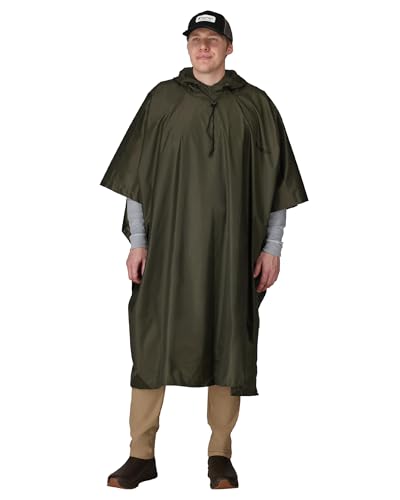
Poncho with grommets for a tarp
Frogg Toggs Waterproof Breathable Poncho Tarp
From the listing · not testedBuy it for hunting stands or camp where you want a quick ground cloth or roof.
Pros
- + Grommets on all four corners turn the 55 by 48 in poncho into a 55 by 96 in tarp, per the listing
- + Polyester ripstop, adjustable hood, three snaps on each side
Cons
- - No seam or waterproof figures on the listing, and nothing on pack fit

Travel, town and events
Totes Adult Packable Poncho
From the listing · not testedBuy it for theme parks, games and city rain, not for backcountry trips.
Pros
- + Reusable, hooded, with side snaps; packs into its included pouch
- + Loose, open cut for airflow, per the listing
Cons
- - No fabric, seam or waterproof specs listed
Frequently Asked Questions
How big a poncho do I need to cover a backpack?
Look for a size the maker says fits a pack, not just a person. Sea to Summit's tarp ponchos measure about 57 by 104 inches, per the listings, and are listed to accommodate a large backpack; many one-size ponchos give no pack figure at all.
Can I use a poncho as my only shelter?
In a pinch. Sea to Summit says both tarp ponchos convert to a two-person shelter and that the Nano "can be used as an emergency shelter if needed." It is a small roof, so pitch it low and out of the wind.
Do ponchos work on a bike?
They are a poor fit for trail riding. A loose poncho catches wind and can snag on the bike, and Sea to Summit warns against very windy conditions.
Proof
Sources
Everything this guide relies on, as linked in the text. Last checked September 29, 2026.
- seatosummit.com: Nylon Tarp Poncho
- seatosummit.com: Ultra-Sil Nano Tarp Poncho
- Centers for Disease Control and Prevention: INDEX page
- National Weather Service: Lightning safety
- National Weather Service: Lightning outdoors
WildProofLab is a participant in the Amazon Services LLC Associates Program, an affiliate advertising program designed to provide a means for sites to earn advertising fees by advertising and linking to Amazon.com. Dimensions and ratings are the makers' own.
Amazon prices and availability change often; cards with a live Amazon price show when it was last checked. As an Amazon Associate I earn from qualifying purchases.