Tent Heaters and Carbon Monoxide Safety (2026)
Propane Buddy heaters, oxygen depletion sensors and CO alarms, read against the CDC and CPSC: why no fuel-burning heater runs in a tent you sleep in, and what to buy.
Independently chosen. As an Amazon Associate I earn from qualifying purchases: if you buy through our links, we may earn a commission at no cost to you. How we research
Quick answer
Carry a battery CO alarm, such as Kidde's portable AA model, on any trip where fuel burns near people. A Mr. Heater Portable Buddy is for awake, ventilated heat outside the tent: the CDC says no fuel-burning heater, stove or lantern belongs inside a tent, and no ODS changes that.
In this guide
- A CO alarm that travelsKidde Carbon Monoxide Detector, AA Battery Powered, Portable for Travel or HomeFrom the listing · not tested
- Seeing the CO numberFirst Alert 10-Year Battery Carbon Monoxide Alarm with Digital DisplayFrom the listing · not tested
- Awake heat in open airMr. Heater 9,000 BTU Portable Buddy Radiant Propane HeaterFrom the listing · not tested

Cold-weather campers, hunters and ice anglers who pack a propane heater are caught between two sets of instructions: the maker of "indoor safe" heaters lists tents as a use, and the federal agencies that count carbon monoxide deaths say never. Both are quoted below, followed by the alarm we would carry and the one rule we would not bend.
How we chose: we did not test these heaters or alarms; we read Mr. Heater's spec sheets, the CDC's and CPSC's carbon monoxide guidance and the CPSC's own lab report on camp heaters, and kept only products sold by Amazon.com and in stock on September 29, 2026.
Two alarms and two heaters side by side
| Product | What it does | Key spec (per maker or listing) | Power | Sold by | Amazon price |
|---|---|---|---|---|---|
| Kidde portable CO alarm | CO alarm | Electrochemical sensor, 85 dB | 2 AA | Amazon.com | $19.89 (Amazon, as of Sep 29, 2026, 5:20 PM UTC)Check price |
| First Alert 10-year CO alarm | CO alarm with display | UL 2034, peak-level memory | Sealed 10-year lithium | Amazon.com | $44.00 (Amazon, as of Sep 29, 2026, 5:20 PM UTC)Check price |
| Mr. Heater Portable Buddy | Radiant propane heater | 4,000/9,000 BTU, ODS, tip-over shutoff, 7,000 ft max | 1 lb propane | Amazon.com | $89.97 (Amazon, as of Sep 29, 2026, 5:20 PM UTC)Check price |
| Mr. Heater Little Buddy | Radiant propane heater | 3,800 BTU, ODS, tip-over shutoff, 7,000 ft max | 1 lb propane | Amazon.com | $69.99 (Amazon, as of Sep 29, 2026, 5:20 PM UTC)Check price |
Prices are Amazon's, as of the time shown, and subject to change. Details
Buy the alarm first. It is the only item in this table that tells you carbon monoxide is present.
What the CDC and CPSC say about heaters in tents
The CDC's rule is flat. After two 1999 camping incidents in Georgia killed six people, a propane stove in a sealed tent and a charcoal grill in a zipped tent, its report said camping stoves, camping heaters, lanterns and charcoal grills "should never be used inside a tent, camper, or other enclosed shelter." It added: "Opening tent flaps, doors, or windows is insufficient."
The CPSC's camping safety alert says: "Do not use portable heaters or lanterns while sleeping in enclosed areas such as tents, campers, and other vehicles." It calls this "especially important at high altitudes, where the risk of carbon monoxide poisoning is increased," and counts at least 26 deaths linked to camping equipment from 2006 to 2010.
Stove makers print the same thing on their own gear. MSR's PocketRocket Deluxe instructions read: "Never use this stove in an enclosed space such as a camper, tent, car, or home."
What Mr. Heater says, and where it differs
Mr. Heater sells the Buddy line as indoor safe. Its Portable Buddy page calls the MH9BX an "indoor safe radiant propane heater" and lists tents and campers among its uses, alongside workshops, porches and hunting blinds. The spec table gives a maximum elevation of 7,000 feet.
Mr. Heater's own Buddy series page adds the fine print: the heaters are "restricted from all indoor use in Massachusetts and Canada" and "restricted from use in dwellings in California." It cites Canadian and Massachusetts law against unvented heaters indoors.

So the maker permits what the CDC says never to do. We follow the stricter rule. No fuel-burning heater runs inside a tent we sleep in, and none runs unattended. That leaves the Buddy for what it does well: warming people who are awake, in open air or an open-sided shelter.
An oxygen sensor is not a carbon monoxide alarm
The ODS on a Buddy heater watches oxygen. The CPSC's 2002 lab report, CO Emissions From Portable Propane Radiant Heaters, tested eight camp heaters in a 100 cubic foot chamber. The two with an ODS shut off when oxygen fell to between 18.8 and 19.6 percent, which kept CO under 100 ppm in that test.
The six heaters without an ODS did not. Their steady-state CO peaked between 260 and 2,124 ppm. The same report investigated 12 incidents from 1996 to 2001 involving these heaters: 18 deaths, all in tents, campers, trailers or vehicles.
Read those numbers both ways. An ODS heater is much safer than one without, in a lab chamber, when it works. It still cannot tell you about CO from anything else burning nearby, and it is one sensor you cannot test at camp.
Which CO alarm, and where it goes
The CDC's carbon monoxide page asks for "battery-operated or battery back-up CO detectors near every sleeping area," batteries checked each spring and fall, and replacement "following the manufacturer's instructions or every 5 years." On a trip, that means a battery alarm where people sleep: the camper, the cabin, the truck cab.
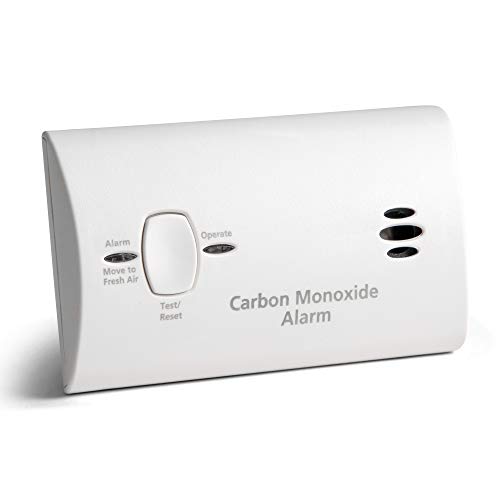
Buy the Kidde portable alarm if you want one alarm that moves between the house, the camper and the gear bin. It runs on two AAs, sits on a table, and its Event Memory shows when it last detected CO or was tested.
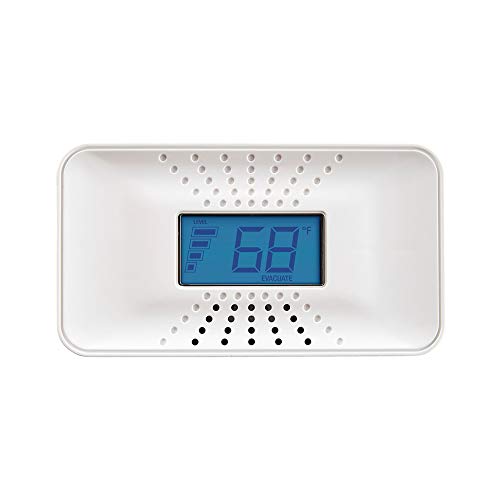
Buy the First Alert 10-year alarm if you want a number. First Alert's CO710 page lists it to UL 2034, and the display shows CO concentration with a peak-level memory. The sealed battery means no battery to forget, and the whole alarm is replaced at end of life.
A CO alarm is a backstop, not a permission slip. It does not make a heater in a closed tent safe; it tells you something has already gone wrong.

Heaters we would buy, and how we would use them
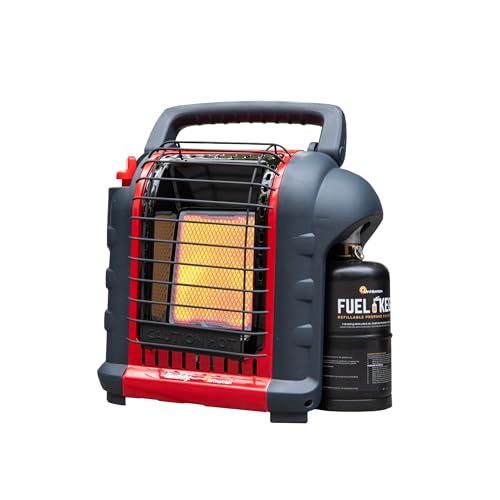
Buy the Portable Buddy for heat you sit in front of: a picnic table on a cold morning, a hunting camp's open-sided kitchen, a workshop with the door open. Mr. Heater rates it at 4,000 or 9,000 BTU and about 225 square feet. Keep it upright, away from fabric, and below its 7,000 ft limit.
Buy the Little Buddy if 3,800 BTU is enough, such as for warming your hands at an ice hole on open ice. The listing gives a tip-over shutoff and low-oxygen shutoff, and Mr. Heater's Little Buddy page lists 5.6 hours on one 1 lb cylinder.
Warmth in the tent comes from what you sleep in. A bag rated to the night's low on its ISO comfort rating and a pad with enough R-value do the job without burning anything.
Related: hand warmers, disposable vs rechargeable, our winter camping checklist.
Heater recalls on record
Our recall database, built from CPSC notices since 2023, shows no recall of the Buddy heaters listed here. It does show one from the same company: in April 2025, Enerco, which registers Mr. Heater warranties, recalled about 21,250 DEWALT 70,000 BTU forced-air propane heaters sold at Lowe's, for fire and burn hazards. Those are outdoor jobsite heaters, not Buddies.
If someone feels sick
The CPSC lists the symptoms as "headache, dizziness, weakness, nausea, vomiting, sleepiness, and confusion," and warns that alcohol and drugs can make them harder to recognize. Turn the heater off and get everyone into fresh air. The CPSC says to see a doctor if anyone develops cold or flu-like symptoms while camping.
The products in this guide
In the order this guide discusses them, from listings, certifications and standards. Where a price appears it is Amazon's, with the time it was read.
A CO alarm that travels
Kidde Carbon Monoxide Detector, AA Battery Powered, Portable for Travel or Home
From the listing · not testedBuy it as the alarm that goes in the camper, the cabin and the gear bin.
Pros
- + Electrochemical sensor on 2 AA batteries, included; wall mount or tabletop, per the listing
- + 85-decibel alarm with a red LED; Event Memory records the last CO detection or test
- + Kidde's listing sells it as portable for travel
Cons
- - No digital readout: it alarms, but does not show a CO level
Seeing the CO number
First Alert 10-Year Battery Carbon Monoxide Alarm with Digital Display
From the listing · not testedBuy it if you want to see a rising CO number before the alarm point, not just hear the alarm.
Pros
- + Backlit display shows CO concentration and temperature; Peak Level recalls the highest reading, per the listing
- + Sealed 10-year lithium battery; First Alert lists its CO710 to UL 2034
- + Built to sit on a tabletop or shelf with no installation, per First Alert
Cons
- - The sealed battery means the whole alarm is replaced at end of life, which the listing says it signals with a chirp
Awake heat in open air
Mr. Heater 9,000 BTU Portable Buddy Radiant Propane Heater
From the listing · not testedBuy it for cold hands at a camp table or an open-sided shelter, and turn it off before anyone zips into a tent.
Pros
- + 4,000 or 9,000 BTU per hour, heats about 225 sq ft, per the listing
- + Low-oxygen shutoff (ODS) and tip-over shutoff, per Mr. Heater
- + Runs on a 1 lb propane cylinder; Mr. Heater sells a hose for a 20 lb tank
Cons
- - Mr. Heater gives a 7,000 ft maximum elevation
- - Not for indoor use in Massachusetts or Canada, per Mr. Heater

A small heater for short sits
Mr. Heater 3,800 BTU Little Buddy Portable Radiant Propane Heater
From the listing · not testedBuy it for a few hours of warmth at an ice hole or tailgate, outside, when the Portable Buddy is more than you need.
Pros
- + 3,800 BTU per hour on one 1 lb cylinder, heats up to 95 sq ft, per the listing
- + Tip-over shutoff and automatic low-oxygen shutoff, per the listing
- + 8-inch round stand; Mr. Heater lists 5.6 hours of run time
Cons
- - One heat setting, and the same 7,000 ft elevation limit
Frequently Asked Questions
Can I run a Buddy heater in my tent if I crack a window?
The CDC says no: its 1999 camping report found that "opening tent flaps, doors, or windows is insufficient to prevent build-up of CO concentrations" from fuel-burning devices. Mr. Heater permits tent use in ventilated spaces, but we follow the agency.
Does the heater's low-oxygen shutoff work at altitude?
Mr. Heater limits both Buddy heaters on this page to 7,000 feet in their spec tables. Above that, leave the heater at home.
Are propane heaters allowed indoors everywhere in the US?
No. Mr. Heater says its Buddy heaters are restricted from all indoor use in Massachusetts and from use in dwellings in California, where unvented heaters are regulated.
How often should I replace a CO alarm?
Follow the maker: the CDC says to replace one per the manufacturer's instructions or every 5 years. First Alert's CO710 has a sealed 10-year battery and a 10-year limited warranty, and chirps at end of life.
Proof
Sources
Everything this guide relies on, as linked in the text. Last checked September 29, 2026.
- Centers for Disease Control and Prevention: Report
- U.S. Consumer Product Safety Commission: Camping Equipment Portable Heater Safety Alert (PDF)
- Cascade Designs (Therm-a-Rest, MSR): PocketRocket Deluxe instructions
- mrheater.com: Portable Buddy page
- mrheater.com: Buddy series page
- U.S. Consumer Product Safety Commission: CO Emissions From Portable Propane Radiant Heaters
- Centers for Disease Control and Prevention: INDEX page
- firstalert.com: CO710 page
- mrheater.com: Little Buddy page
- U.S. Consumer Product Safety Commission: Recalled about 21,250 DEWALT 70,000 BTU forced-air propane heaters
Amazon prices and availability change often; cards with a live Amazon price show when it was last checked. As an Amazon Associate I earn from qualifying purchases.


