Fire Extinguishers and Fire Blankets for Camping (2026)
Small UL-rated extinguishers and fire blankets for camp kitchens, trailers and trucks, compared on each maker's printed rating and the USFA's rules for use.
Independently chosen. As an Amazon Associate I earn from qualifying purchases: if you buy through our links, we may earn a commission at no cost to you. How we research
Quick answer
Keep a UL-rated 1-A:10-B:C extinguisher such as First Alert's rechargeable HOME1 in the camp kitchen box, and a fire blanket beside the stove for a pan fire. For the vehicle, Kidde's Auto 10 is rated 10-B:C for fuel and electrical fires, with no Class A rating.
In this guide
- The camp kitchen boxFirst Alert HOME1 Rechargeable Fire Extinguisher, 1-A:10-B:CFrom the listing · not tested
- A second unit for the tent siteKidde Basic 110 Fire Extinguisher, 1-A:10-B:C, FA110GFrom the listing · not tested
- Basecamp or a trailerKidde Living Area Fire Extinguisher, 2-A:10-B:C, KD143-210ABCFrom the listing · not tested


A camp kitchen puts an open flame, a pan of hot oil and a pressurized fuel canister within arm's reach of a nylon tent, and a car camper adds fuel lines and wiring. The equipment that covers those fires is small and cheap, but only if you buy the right rating and know when to walk away instead.
How we chose: we did not test these extinguishers or blankets; we read the UL ratings and specs on the makers' listings and spec sheets, the U.S. Fire Administration's guidance and the CPSC's warnings, and kept only products sold by Amazon.com or the brand's own store and in stock on September 29, 2026.
Four extinguishers and two blankets side by side
| Product | Rating (per listing) | Agent | Discharge (per listing) | Refill | Sold by | Amazon price |
|---|---|---|---|---|---|---|
| First Alert HOME1 | 1-A:10-B:C, UL | Dry chemical | Not stated | Rechargeable by a pro | Amazon.com | $19.98 (Amazon, as of Sep 29, 2026, 5:20 PM UTC)Check price |
| Kidde FA110 | 1-A:10-B:C, UL | 2.5 lb dry chemical | Not stated | Single use | Amazon.com | $19.97 (Amazon, as of Sep 29, 2026, 5:20 PM UTC)Check price |
| Kidde KD143 Living Area | 2-A:10-B:C | 4 lb dry chemical | 13-15 s, 12-18 ft | Single use | Amazon.com | $43.98 (Amazon, as of Sep 29, 2026, 5:20 PM UTC)Check price |
| Kidde Auto 10 | 10-B:C, UL | 2.9 lb sodium bicarbonate | 8-12 s, 6-8 ft | Single use | Amazon.com | $20.84 (Amazon, as of Sep 29, 2026, 5:20 PM UTC)Check price |
| SecuCaptain fire blanket | Cites EN 1869:2019 | Fiberglass, 40 x 40 in | n/a | n/a | SecuCaptain | $23.99 (Amazon, as of Sep 29, 2026, 5:20 PM UTC)Check price |
| WUERLI fire blanket | Cites EN 1869:2019 | Fiberglass, 40 x 40 in | n/a | n/a | WUERLI | $16.99 (Amazon, as of Sep 29, 2026, 5:20 PM UTC)Check price |
Prices are Amazon's, as of the time shown, and subject to change. Details
The extinguisher ratings are the class ratings on each listing; the HOME1, FA110 and Auto 10 listings also say UL listed or rated. The blanket figures are the sellers' own claims; neither names who tested them.
How to read 1-A:10-B:C
The U.S. Fire Administration's extinguisher page explains the label. The number before the A is a multiple of 1.25 gallons of water on ordinary materials like wood, cloth and paper. The number before the B is the square feet of burning liquid the unit can put out. C means the agent does not conduct electricity.
So a 1-A:10-B:C unit gives the equivalent of 1.25 gallons of water on a burning camp chair and handles a 10 square foot fuel spill. A 2-A:10-B:C doubles the Class A figure. The USFA says to look for the "UL Listed" label and to pick "the largest fire extinguisher that a user can safely and comfortably operate."
For a camp kitchen, that points to an ABC unit. The kitchen's fires are a mix: a grease flare-up is Class B, a burning tablecloth or tent wall is Class A, and a lantern or a power station adds Class C.

Pan fires: lid or blanket first
The USFA's cooking fire advice is to keep a pan lid or baking sheet nearby: "Use it to cover the pan if it catches on fire." On a camp stove the same idea applies. Smother it, turn off the burner, and leave the cover on until the pan cools.
A fire blanket is a bigger lid. SecuCaptain's listing gives the sequence: pull the tabs down, cover the fire slowly without yanking it back, turn off the heat, and lift the blanket only once the temperature has dropped. Lifting early lets air back in.
Where a blanket beats an extinguisher is the cleanup. A dry-chemical discharge coats the stove, the food and the kitchen box in powder. A blanket leaves nothing behind but the blanket.
What the blanket listings claim
Four blanket listings we read each claim a European fire blanket standard. SecuCaptain and WUERLI cite EN 1869:2019; Demiwise cites EN 1869:1997. Prepared Hero's listing cites "EN 1896:1997," a different number, so ask the brand which standard it means before relying on it.
None of the listings names a testing laboratory or certificate. Treat the standard as a claim, like the 580°C (1,076°F) heat figure SecuCaptain and WUERLI both print.
Recalls and warnings to know
The CPSC has flagged two kinds of products sold as easier than an extinguisher. In March 2024 it warned consumers to stop using Elide fire extinguishing balls, which lack a pressure gauge, a locking device, a self-closing valve and a nozzle required by UL 299, the standard for dry-chemical extinguishers.
In September 2026, Prepared Hero recalled about 31,000 Hero Fire Spray canisters with date code 09/2024, sold on Amazon and its own site, because they "can deteriorate overtime, causing it to rupture and fail to operate during a fire." Its fire blankets were not part of that recall.
Which extinguisher for which camp
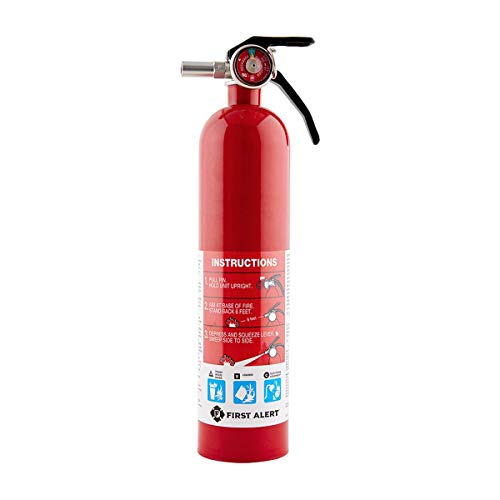
Buy the First Alert HOME1 for the kitchen box. It is UL rated 1-A:10-B:C, all metal at the valve, and First Alert's HOME1 page says a certified professional can recharge it after use. At 5.4 lb and 14.3 inches it stands upright in most bins.
Buy the Kidde FA110 as the second unit, at the tent or trailer door, so the extinguisher is not beside the fire you need it for. It carries the same 1-A:10-B:C rating with 2.5 lb of agent, and it is single use.
Buy the Kidde KD143 for base camps and trailers. Its 2-A rating and 12 to 18 ft range, per the listing, keep you farther from the flames. Buy the Kidde Auto 10 for the vehicle, knowing it is rated only for Class B and C fires.
For the kitchen setup itself, see our camp kitchen storage boxes and fire pit mats.

When to use it, and when to leave
The USFA's checklist says to use an extinguisher only when every answer is yes: others have been alerted, someone has called the fire department, you are physically able, the fire is "small and contained in a single object or to a surface (like a pan or a wastebasket)," you are clear of the smoke, and you have "a clear escape route." It adds that young children and older adults should not use one.
Then remember PASS: pull the pin, aim low at the base of the fire, squeeze the lever slowly and evenly, and sweep side to side. A fire that has reached the tent wall, the trees or the vehicle's cab fails the "small and contained" test.
An extinguisher is not how you put out a campfire
The USFA says to build campfires "at least 25 feet away from tents, shrubs and anything that can burn," per its outdoor fire page. A campfire is put out with water, stirring and the back of your hand, as our fire pit mat guide covers. The extinguisher is for the fire that escapes.
The USFA also lists the checks: the gauge in the green, nothing blocking the extinguisher, no dents or rust on the can, hose or nozzle. Some extinguishers need to be shaken monthly and others pressure tested every few years, per the maker's instructions.
The products in this guide
In the order this guide discusses them, from listings, certifications and standards. Where a price appears it is Amazon's, with the time it was read.
The camp kitchen box
First Alert HOME1 Rechargeable Fire Extinguisher, 1-A:10-B:C
From the listing · not testedBuy it as the one extinguisher that lives in the kitchen box and gets serviced instead of thrown out.
Pros
- + UL rated 1-A:10-B:C, all-metal valve and trigger, per the listing
- + Rechargeable by a certified professional after use; U.S. Coast Guard approved for marine use, per the listing
- + 5.4 lb and 14.3 in tall, per First Alert's spec sheet
Cons
- - Recharging means a trip to a fire equipment service, not a refill at camp
A second unit for the tent site
Kidde Basic 110 Fire Extinguisher, 1-A:10-B:C, FA110G
From the listing · not testedBuy it for a second extinguisher at the tent or trailer door, away from the stove.
Pros
- + UL listed 1-A:10-B:C with 2.5 lb of agent, per the listing
- + Coast Guard and DOT approved; strap bracket included
- + 12-year service-free design and a pressure indicator, per Kidde
Cons
- - Residential and single use: once discharged, replace it
Basecamp or a trailer
Kidde Living Area Fire Extinguisher, 2-A:10-B:C, KD143-210ABC
From the listing · not testedBuy it for a base camp, a hunting camp or a travel trailer where weight does not matter.
Pros
- + Rated 2-A:10-B:C with 4 lb of agent, per the listing
- + 13 to 15 seconds of discharge and a 12 to 18 ft range, per the listing
- + Metal valve assembly and a 12-year service-free design
Cons
- - Single use, and heavier than the 1-A units

Fuel and wiring fires in a vehicle
Kidde Auto 10 Fire Extinguisher for Cars and Trucks, 10-B:C, M10G
From the listing · not testedBuy it for the truck or the car-camping rig, and keep an ABC unit for the camp kitchen.
Pros
- + Rated 10-B:C for flammable liquids, gases and electrical equipment, per the listing
- + 2.9 lb of sodium bicarbonate; 8 to 12 seconds of discharge at 6 to 8 ft
- + UL listed, with a strap bracket for mounting
Cons
- - No Class A rating: not the one to grab for burning wood, paper or fabric

A pan fire on the camp stove
SecuCaptain Emergency Fire Blanket, 40 x 40 in, 4 Pack
From the listing · not testedBuy it to hang beside the stove and a second one for the vehicle.
Pros
- + Two layers of woven fiberglass with an inner fire-retardant film, per the listing
- + The listing cites EN 1869:2019 and a 580°C (1,076°F) heat rating
- + Pull tabs treated to resist heat, and printed use steps: cover slowly, turn off the heat, lift only once cool
Cons
- - No test lab or certificate number is given for the EN 1869 claim

Kitchen box and glovebox pair
WUERLI Fire Blanket for Home and Kitchen, 40 x 40 in, 2 Pack
From the listing · not testedBuy it if you want two blankets, one for the kitchen and one for the car.
Pros
- + Fiberglass, 0.5 mm thick and 500 g, per the listing
- + The listing cites EN 1869:2019 and a 1,076°F (580°C) rating
- + Hanging hook for storage by the grill or in a cabinet
Cons
- - Like the others, no test lab or certificate number is named
Frequently Asked Questions
Does a car extinguisher need a Class A rating?
Not for fuel and wiring fires, which are Class B and C. Kidde's Auto 10 is rated 10-B:C. If you also want it for a burning seat or cargo, carry an ABC unit such as the 1-A:10-B:C FA110.
Can I reuse a fire blanket?
We would not. SecuCaptain and WUERLI say their blankets never expire, but neither listing explains how to check one after it has smothered a fire, so we would replace it.
Is a Class K extinguisher needed for a camp stove?
The USFA describes Class K as for "vegetable oils, animal oils and fats in cooking appliances" and says it is often found in commercial kitchens. For a pan on a camp stove, a lid or fire blanket comes first.
Where do I get a rechargeable extinguisher recharged?
First Alert says the HOME1 can be recharged "by a certified professional," which means a fire extinguisher service company. The USFA suggests asking your local fire department about extinguisher training.
Proof
Sources
Everything this guide relies on, as linked in the text. Last checked September 29, 2026.
- usfa.fema.gov: Fire extinguishers
- usfa.fema.gov: Cooking fire advice
- U.S. Consumer Product Safety Commission: CPSC Warns Consumers to Immediately Stop Using Elide Fire Extinguishing Balls Due to Failure to Extinguish Fires and Risk of Serious Injury or Death
- U.S. Consumer Product Safety Commission: Prepared Hero Recalls Fire Spray Canisters Due to Risk of Serious Injury or Death from Fire and Burn Hazards
- firstalert.com: HOME1 page
- usfa.fema.gov: INDEX page
Amazon prices and availability change often; cards with a live Amazon price show when it was last checked. As an Amazon Associate I earn from qualifying purchases.


